Is your respect for the old merely from a sense of duty? Do you feel the same way about roasted meat?
from E. R. Hughes, Chinese Philosophy in Classical Times, p. 99
Wisdom is wisdom no matter who offers it, just as roasted meat is good no matter who roasts it. Mencius’s point was that genuine moral perception—like the appreciation of good food—is natural, immediate, and unforced. It is recognition, not obligation. This paper asks the reader to evaluate the argument, not the source.
The Problem
A republic, madam — if you can keep it.
Societies regulate behavior through two fundamentally distinct mechanisms. In the first, people cooperate because they possess internalized moral commitments—conscience, empathy, community accountability. In the second, people comply because external authority compels them—through statutes, surveillance, punishment, and institutional power.
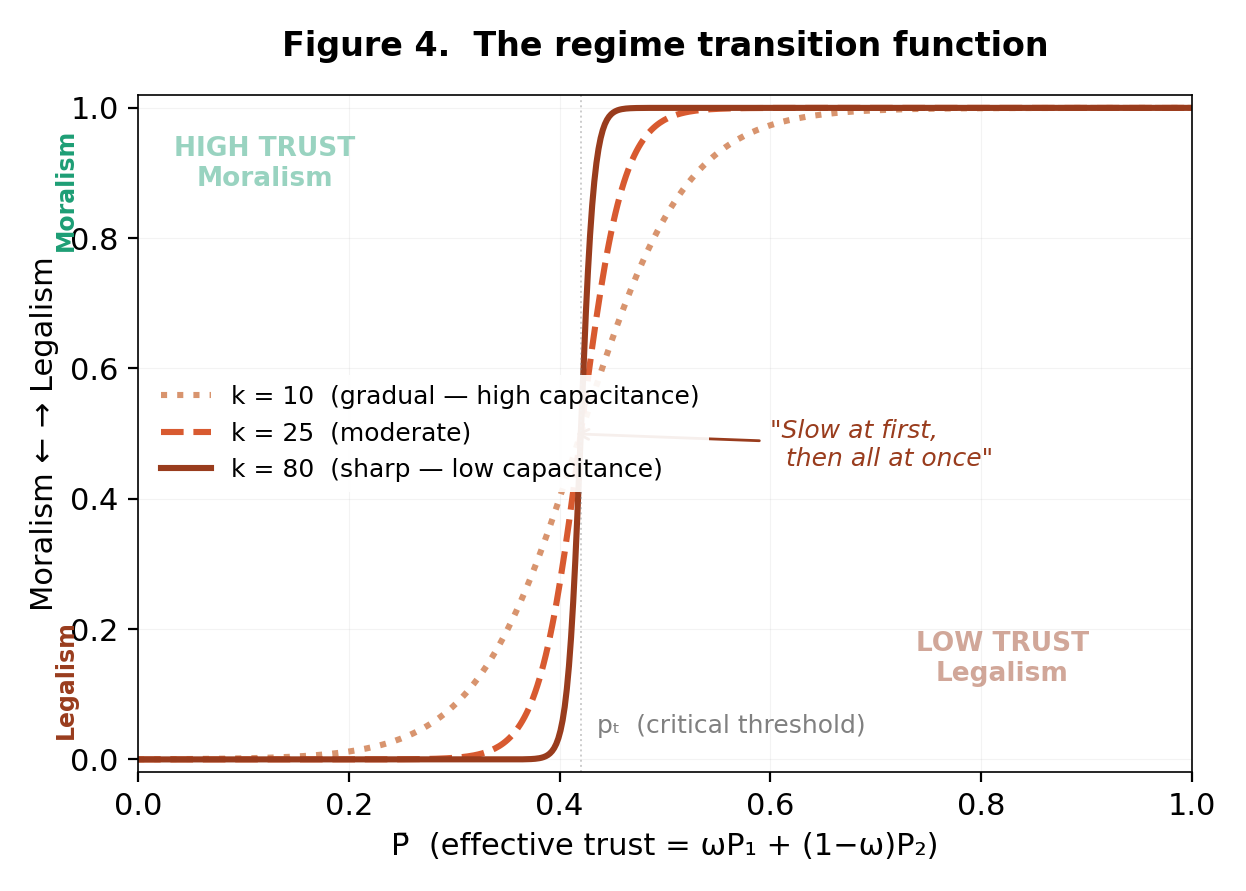
These are not two points on a spectrum. They are two distinct regimes of a single dynamical system, separated by a critical threshold. A society does not gradually slide from one to the other. It appears stable for extended periods, then undergoes rapid, often irreversible transformation. Slow at first, then all at once. Franklin understood: the republic was moralist by design, and its survival depended on the moral formation of its citizens—something that could not be guaranteed.
This paper formalizes the dynamics of that transition. It shows that interpersonal trust is the load-bearing variable of civilization, that institutional power functions as a system of trust-to-wealth conversion, and that the process is autocatalytic—it consumes the only force capable of restraining it.
Seven Observers, One System
Seven thinkers across 2,500 years described aspects of the same phenomenon. Each saw the system from a different position along the trust curve. None had the complete picture. Together, they define the landscape.
| Thinker | Observation | Position in the model |
|---|---|---|
| Confucius | Moral example governs; law displaces virtue | High-trust equilibrium; the displacement mechanism |
| C. S. Lewis | Moral formation is being systematically destroyed | Capacitance depletion; early P₁ decline |
| Bastiat | Law perverted into an instrument of plunder | Extraction dynamics; institutions become net-negative |
| Bonhoeffer | The unreflective maintain systems they don’t understand | Actor distribution in the legalist apparatus |
| Breitbart | Politics is downstream of culture | Culture–politics coupling tightens at the threshold |
| Carneades | Justice is real (day one) and fictional (day two) | Both regimes seen; mistaken for a paradox |
| Thrasymachus | Justice is the interest of the stronger | Accurate within the legalist regime only |
Each observer identified a fragment. The model reveals they were describing the same system from different positions within it—like seven people describing an elephant from different angles, each accurate about what they touched, each incomplete about the whole. Carneades saw both regimes in two days and mistook them for a philosophical paradox rather than two phases of a dynamical system.
The Trust Hierarchy
Trust is not a single variable. It decomposes into a layered structure that determines not merely how much trust a society possesses but how widely it distributes.
Insider trust is the evolutionary default—trust within family, clan, and immediate community. It is generated primarily through family. Outsider trust is the civilizational breakthrough—trust extended to strangers. It is generated through religion and culture: shared moral frameworks that extend ethical obligations beyond one’s kin. Institutional trust allows societies to scale further, but it rests on interpersonal trust underneath it. When P₁ collapses, P₂ is living on borrowed time.
The Dynamics
The transition between moralism and legalism follows a hyperbolic tangent function—the mathematical shape of “slow at first, then all at once.” When trust is high, small losses barely register. Near the critical threshold, small losses trigger rapid regime change. Below the threshold, the system locks into legalism.
The full model tracks five variables: interpersonal trust, institutional trust, legalism, trust capacitance, and the extraction rate. Their interactions produce a characteristic trajectory: P₁ erodes gradually while P₂ remains high—the society looks stable and institutions appear strong. Then, as effective trust crosses the threshold, legalism spikes, extraction surges, and P₂ crashes.
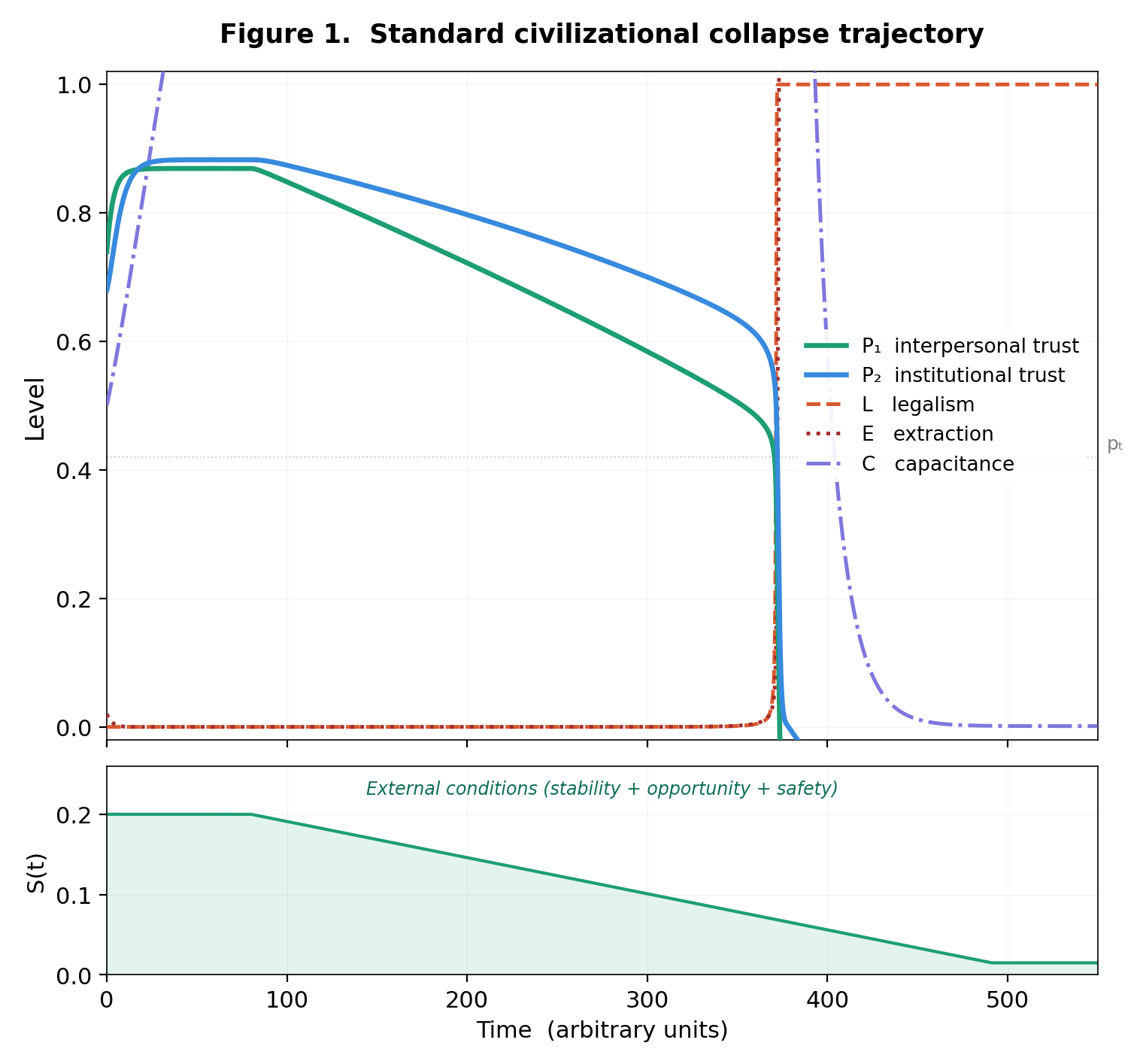
The ratchet mechanism is autocatalytic: legalism erodes trust, which raises legalism further, which depletes capacitance, which accelerates extraction, which further erodes trust. The only endogenous brake is moral self-regulation—and it is proportional to the very quantity the engine consumes. The system consumes itself.
The Ironic Cycle
The model reveals a structural irony at the heart of civilization: trust builds prosperity, and prosperity erodes trust.
When times are hard, people need each other. Cooperation is a survival requirement. Mutual dependence builds P₁ₒ through practical necessity. Then prosperity arrives—and people can afford not to need each other. Every problem that once required a trust relationship now has a market or institutional solution. Each substitution is individually rational. Each one removes an edge from the trust network. The network doesn’t collapse—it is bought out, one edge at a time.
The generation that built the prosperity remembers the interdependence. Their children don’t. They grew up in a world where institutional solutions existed for every problem. They are Lewis’s men without chests—not because someone destroyed their moral formation but because prosperity made it unnecessary.
This connects to the old adage: shirtsleeves to shirtsleeves in three generations. The first generation builds through cooperation. The second manages with transmitted knowledge. The third inherits with no memory of creation and consumes the capital—both financial and moral. Three generations. Roughly 80 years. The same timescale as the Strauss-Howe generational cycle.
The Generational Cycle
Strauss and Howe’s Fourth Turning describes an 80-year cycle: the High (post-crisis rebuilding), the Awakening (prosperity breeds questioning), the Unraveling (trust visibly declining), and the Crisis (threshold crossed). The cycle length is not arbitrary—it is the lifespan of the generation that remembers.
As long as someone who lived through the last crisis is alive, their visceral memory functions as living capacitance. When the last member of that generation dies, the knowledge becomes abstract—something in history books rather than something your grandmother told you with tears in her eyes. Abstract knowledge doesn’t charge capacitance the way lived experience does.
The Filial Transmission of Morality
During the Great Depression, one family kept egg sandwiches for beggars who came to the door. If a stranger needed shelter, the grandfather put them up and fed them breakfast. A great uncle housed an indigent painter for several weeks; the man repaid the kindness by painting an extraordinary mural of Clydesdale horses on the barn doors. No contract. No program. No institution. Just one man’s need and another man’s conscience. That mural still stands.
The grandmother in that family told her children: “A beggar could be Jesus Christ in disguise.” That is Matthew 25—and it may be the most efficient P₁ₒ generation mechanism ever devised. It places the strongest possible moral authority inside the stranger, making it impossible to treat any person as outside your moral circle.
The grandmother generated the trust. Her daughter stored and transmitted it through family stories. Her grandson formalized why it matters. Three generations: the act, the story, the framework. That is capacitance charging through family narrative—P₁ᵢ transmitting P₁ₒ values.
Only communities that maintain moral formation during prosperity have broken the ironic cycle beyond three generations. Every lasting example—the Amish, the Mennonites, the Mormons—is religious. The secular counterexamples dissolved by the third generation. The structural properties that religion provides—non-negotiable moral authority, daily practice, identity-embedded formation, intergenerational transmission through ritual—appear necessary for sustaining P₁ through prosperity.
The Subsidized Legalist State
The model predicts that a pure legalist regime cannot sustain itself. North Korea is the test case. It cannot feed itself, fuel itself, or house itself. It persists because China provides external life support. North Korea is a man on an iron lung. The machine isn’t healing the patient—it’s preventing the absence of breathing from being fatal.
North Korea runs on three iron lungs: Chinese economic subsidy replacing cooperative surplus; a total propaganda machine replacing legitimate P₂; and the three-generation punishment policy that hijacks P₁ᵢ — turning family love into the regime’s most effective enforcement mechanism. Yeonmi Park described how her mother told her that her mouth was the most dangerous part of her body—because it could condemn her entire family. You don’t speak because you love your family. The strongest bond becomes the most effective chain.
The relationship is non-reciprocal: the parent loves the child unconditionally; the institution uses the citizen conditionally. When utility expires, the institution discards—as the Soviets discarded Pavlik Morozov, the boy who informed on his parents and was honored with statues before starving to death.
The Permanence of Collapse
The collapse threshold is lower than the recovery threshold. Four mechanisms drive irreversibility: capacitance depletion, moral skill atrophy, network fragmentation, and institutional lock-in. When the moral formation institutions that would rebuild trust have themselves been consumed during prosperity, there is nothing left to generate P₁ when necessity returns.
The Fertile Crescent civilizations collapsed millennia ago. The rivers still flow. The soil is still fertile. What was lost was the trust infrastructure. Because interpersonal trust is non-renewable on civilizational timescales, extraction is mining, not harvesting. This is why collapsed civilizations stay poor. The trust mine is empty.
A Framework for Discernment
This model is not a prescriptive instrument. It is offered as a framework for discernment—an aid to moral perception that equips individuals and communities to see where they stand on the trust curve, which direction they are moving, and what forces are operating on them.
The act of measuring trust itself affects trust. When institutions create “trust metrics,” they convert interpersonal trust—an organic, lived reality—into an institutional measurement, subjecting it to the very processes that erode it. Discernment is a capacity that exists only in the presence of moral formation. The framework is self-selecting: it functions as designed only in the hands of those who do not need to be told not to weaponize it.
The seeds of any recovery are planted not in policy but in moral formation: families, communities, religious traditions, and the daily practice of trusting and being trustworthy. They cannot be legislated into existence.
The full working paper contains the complete dynamical system, nine reduced dimensionless parameters, historical case studies, laboratory evidence (Milgram, Zimbardo), the Pareto structure of the legalist apparatus, cultural capture dynamics, seven falsifiable predictions, and the philosophical unification of seven observers across 2,500 years.
Download the full paper (DOCX)Glossary & Technical Reference
Communitarian (high P₁, low P₂): localist, vulnerable to charismatic capture.
Bounded trust (high P₁ᵢ, low P₁ₒ, high P₂): strong clans, limited scalability.
Legalist (low P₁, high P₂): bureaucracy replaces morality.
Failed state (low P₁, low P₂): Thrasymachus universally correct.
Subsidized legalist: extraction sustained by external patron. Man on an iron lung.
The Nine Dimensionless Parameters
The system’s qualitative behavior depends on nine ratios:
| Parameter | Name | What it asks |
|---|---|---|
| k | Cultural susceptibility | How sharply does the society snap between regimes? |
| pₜ | Critical threshold | At what trust level does the regime flip? |
| ω | Trust weighting | How dominant is P₁ relative to P₂? |
| ν₂/ν₁ | Institutional stickiness | How much slower do institutions decay than personal trust? |
| ε/ν₁ | Legalist amplifier | How much faster does legalism erode trust than natural decay? |
| κ₁₂/κ₂₁⁰ | Coupling asymmetry | How much stronger is the P₁→P₂ channel? |
| β/α | Crash asymmetry | How much faster does P₂ collapse than P₁? |
| δ/λ | Irreversibility ratio | How much faster does capacitance drain than charge? |
| ξ/φ | Extraction balance | Does extraction outpace moral suppression? |
The irreversibility ratio (δ/λ) controls hysteresis width. The extraction balance (ξ/φ) determines whether the engine runs away. When ξ/φ exceeds unity at current P₁, the meltdown is underway.